
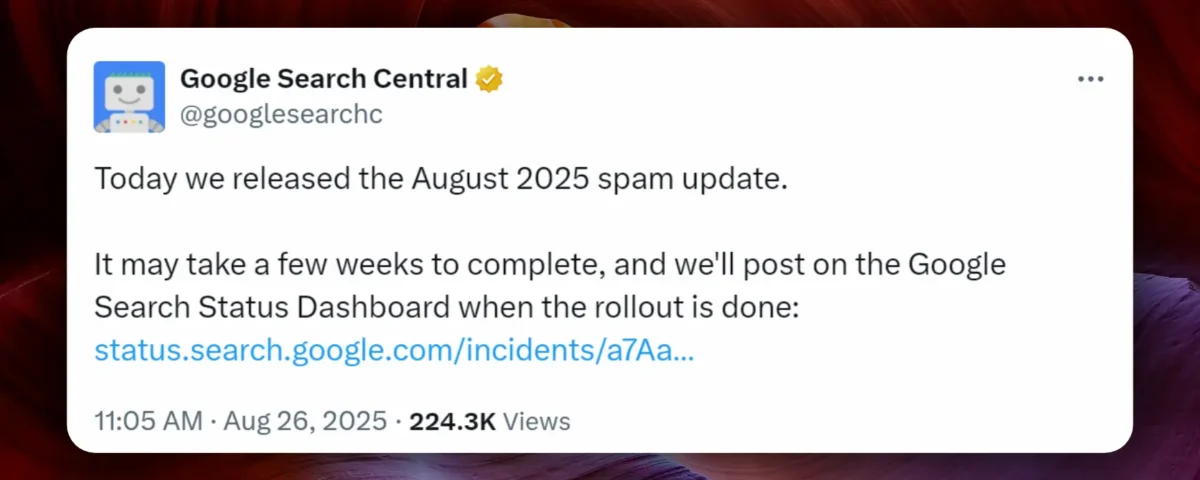
On August 26, 2025, Google launched its latest spam update. Most agencies are scrambling to understand the impact. We saw it coming weeks ahead.
Our method sounds almost primitive. We manually watch search engine results pages from various devices alongside our rank tracking software.
The patterns revealed this update would target specific spam violations while leaving others untouched.
Spam Becomes Our Early Warning System
When we start seeing spam results flood our clients’ search queries, we know an algorithm update is coming. The spammers always arrive first.
Parasite SEO tactics exploded across LinkedIn, Reddit, and Medium after Google’s Helpful Content Update.
Black hat SEOs figured out how to game these high-authority platforms, ranking pages for keywords they had no business targeting.
Reddit threads became particularly problematic, with 51% containing spam links designed to manipulate product-related searches.
We watched this spam proliferation knowing Google would eventually respond. The August 2025 spam update proved our prediction correct.
Since the update began rolling out, those parasitic pages have declined significantly in our clients’ search results. Real businesses are climbing back to the top.
What the August 2025 Update Actually Targets
Based on Barry Schwartz’s reporting, this update has specific parameters that many agencies are missing.
The rollout takes three weeks to complete globally, impacting all regions and languages. But here’s what most people don’t understand about its scope.
This update does NOT target link spam. It does NOT target site reputation abuse policies. Google was very specific about what it excludes.
Instead, it penalizes other spam techniques that violate Google’s search spam policies. The exact techniques remain undisclosed, but our monitoring suggests it focuses on content manipulation and deceptive practices.
Recovery timelines are brutal. Google warned it can take many months to recover, even with periodic refreshes to the spam update.
Protection Through Principles, Not Gaming
When we spot spam techniques working temporarily, we don’t adopt them.
We reinforce our best practices instead.
This approach has served our team of 20 marketing experts well. As Wisconsin’s highest-rated advertising agency and Ozaukee County’s Business of the Year, we’ve learned that sustainable SEO success comes from anticipating Google’s moves, not reacting to them.
Guest posting used to be standard SEO strategy. Now Google considers it spam. We stopped recommending it to clients years ago when we saw the writing on the wall.
The same pattern is happening with AI content. Mass-producing articles with ChatGPT without human input will become the next guest posting.
Google’s official policy already states that using AI to manipulate rankings violates their spam guidelines. The crackdown is coming.
Our Content Process
When we write content for clients, we extract authentic insights through a simple process. We brief them on the article topic and ask them to record a voice memo sharing what they know about that subject.
This methodology stems from our proprietary Vertz Digital Marketing Method™, developed through academic research at Harvard University. The framework focuses on integrating authentic business expertise with proven digital marketing strategies.
A roofing contractor doesn’t think like a content creator. But they know things about roofing that nobody else does.
We ask questions about things people may not know or things nobody is talking about. The goal is finding an angle that makes the content stand out.
For one client, we discovered a gap around vehicle compatibility in their product niche. We created twenty new pages targeting searches where no content existed previously.
The search volume was low according to Ahrefs and SEMrush. But one additional converting customer per month made the effort worthwhile because of the high lead value.
The Simple Litmus Test
Every page on a website needs intent. If it provides no value to readers or potential customers, we no-index it.
Our litmus test is straightforward. If you type a query into Google, would you expect this page to appear in results?
A blog post about how a company redesigned their website might interest current customers. But nobody searches for that information.
Pages without search intent get no-indexed, regardless of whether the client sells high-ticket commercial products or lower-value services.
The Future Belongs to Authentic Collaboration
The SEO industry is splitting into two camps. Agencies that outsource everything to contractors will struggle with future algorithm changes.
Agencies that work directly with clients to extract deeper insights and knowledge will thrive.
Over our years serving hundreds of small and mid-sized businesses across Wisconsin and the Midwest, we’ve seen this truth play out repeatedly. Companies that maintain close partnerships with their marketing teams consistently outperform those that treat SEO as a commodity service.
Everyone still focuses heavily on backlinks, which remain important in 2025. But the shift is toward link quality over quantity.
Naturally acquired links will always outperform paid placements. Websites that actively sell links eventually link to so many irrelevant sites that Google can easily identify them.
The pattern recognition continues. Google’s spam detection evolves, but the fundamental principle stays constant.
Authentic value wins over manipulation tactics. Every time.
Recovery Strategy for Hit Sites
If your site was impacted by the August 2025 update, Google’s advice is straightforward but challenging. Review their spam policies to ensure compliance.
The recovery timeline extends months, not weeks. Google will implement periodic refreshes, but patience becomes essential.
We’re monitoring client sites daily during this three-week rollout period. The patterns we’re seeing suggest this update targets content farms and manipulative publishing practices more than technical spam.
Sites with authentic, user-focused content remain stable. Sites gaming the system through content manipulation are seeing significant drops.
AI Overviews Continue to Be Problematic for Publishers
Beyond the spam update itself, we’re observing a concerning trend across client accounts. Impressions are climbing while clicks decline significantly.
This pattern stems from Google’s AI Overviews having a larger impact on the overall web ecosystem. The AI systems scrape content from publishers and present answers directly in search results, reducing the need for users to click through to websites.
Unfortunately, publishers can’t avoid this reality. Less traffic from these queries represents the natural evolution of the internet as autogenerated AI systems continue expanding their reach.
We keep watching the search results manually, tracking these specific patterns, and protecting our clients by staying ahead of the curve. While others react to algorithm updates, we prepare for them.
The August 2025 spam update proves our methodology works. The spam always tells us what’s coming next.